Saturday, February 26, 2011

TWO DAYS: Napa to Mendocino to Arcata

DAY ONE: NAPA to MENDOCINO

Downtown Napa
A. Paul & I finally encountered our first cell-less, wireless stay in Mendocino, so tonight's blog will catch up on our art tour over the past two days.

We landed in Napa Valley on Wednesday night and awoke to an overcast day as we set out to explore the wine country.  Our first excursion was to the old historic town of Napa founded in 1847. Prior to the business of the vineyards, Napa's economy, much like the economy of other small towns of Northern California, was tied to cattle, timber and mining-both gold and silver.  The shifts in the economy brought new migrants to the area and, among those, creative individuals who attempted  to capture the landscape and activities of the valley which continues in the contemporary artwork of today.    

Not unlike our previous finds in other communities, there were many storefronts lining the downtown that sat empty. Some of these, galleries that were not able to weather the economic woes felt by so many across the nation.  A. Paul & I headed north to see how other communities in the wine country were faring. 

L-R: Thomas, Kerry, & Chistopher
standing in front of Jeremy Mann artwork
 Our next stop was in St. Helena where we met up with gallery owner Christopher Hill and his associate Thomas Paul Smith at the Christopher Hill Gallery.   Within minutes, A. Paul & I felt at home in this gallery.  Both Christopher & Thomas gave us a warm welcome, answering our many questions about the gallery, its artists, and the area.  We were fortunate to see several of Jeremy Mann's works currently on display along with some exceptional, evocative pieces by international artists, who make up the bulk of the gallery artists.   The goal of much of the nontraditional work at the gallery, according to Christopher Hill, is to "engage the viewer and entice him or her to look beyond the norm of what is comfortable."   To this end, Hill has carefully selected represented work that reflects less of the environmental landscape of the wine country and more urban, abstract, and expressionist pieces.  The Christopher Hill Gallery has been successfully in business about 10 years with a stable of approximately 20 represented artists http://www.chgallery.com/   Thank you Christopher and Thomas for taking the time to speak with us and for the wonderful gift as we departed.  We hope to see you in Provincetown to return the hospitality.

As we walked the rest of St. Helena's small but quaint downtown, A. Paul & I noticed that the town seemed to be surviving the national economic crisis more favorably than its neighboring communities. The shops lining the streets were open for business with few to none vacant buildings. 

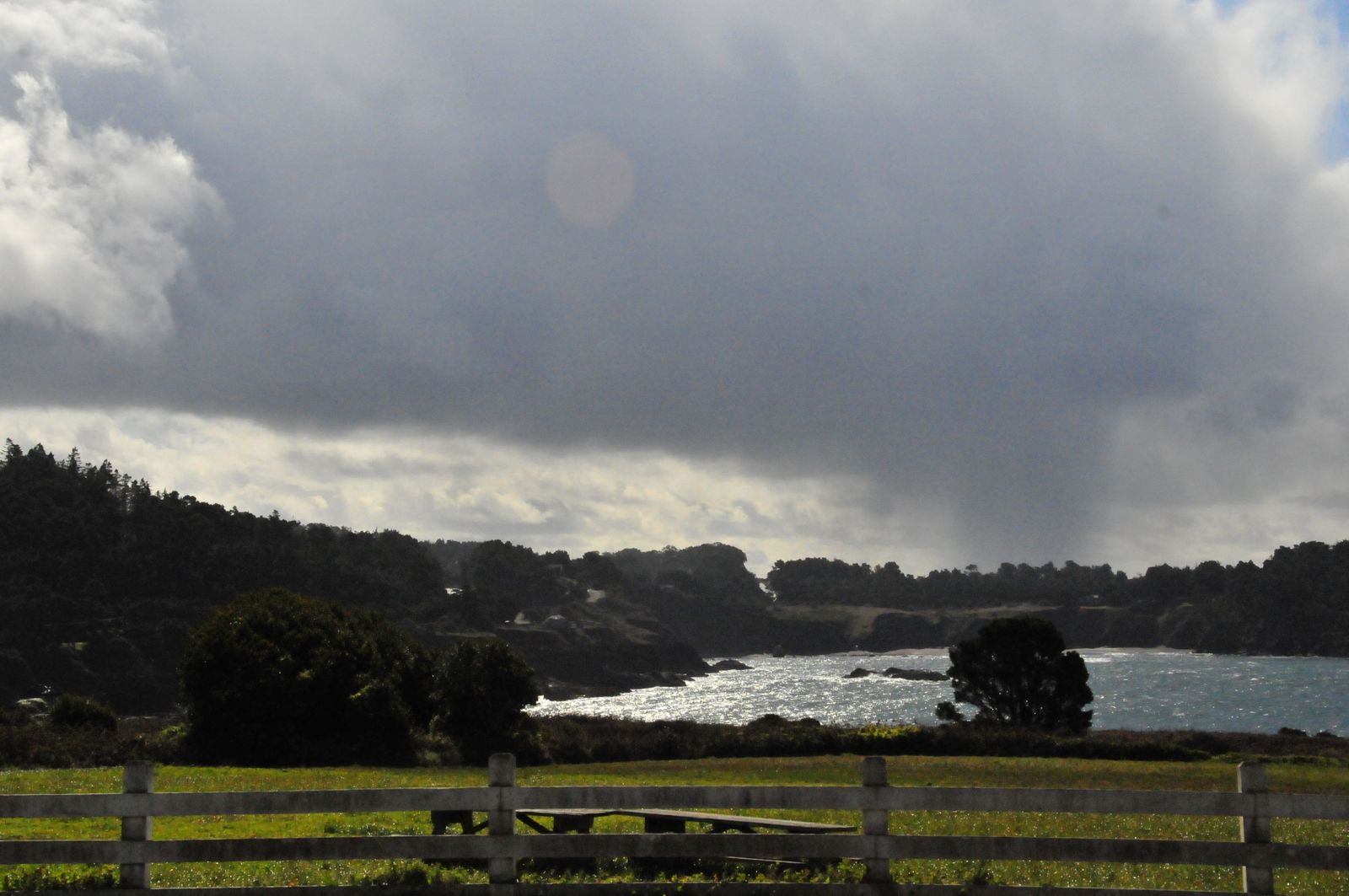
Following a quick lunch and stop in Calistoga ,where we visited a couple additional galleries including the Lee Youngman galleries http://www.leeyoungmangalleries.com/ , we began our trek westward across the rolling mountains that separate the wine country and the seaside town of Mendocino.  The rain did catch up with us throughout the day but it made for a reflective drive through the hills as seen in the images.  We landed just in time to settle in at the historic 19th c. Mendocino Hotel situated across from the Pacific Ocean.  Unfortunately, the dark of the evening settled in quickly so we had to wait until daylight to take in the breathtaking views Mendocino has to offer, which completely offset the inconvenience of not having cell or wireless access.

Slideshow:  Napa to Mendocino   (Day Two follows the slideshow)


Main Street Mendocino
DAY TWO:  MENDOCINO to ARCATA
When morning came, the sky had cleared and the seaside village of Mendocino could not have been more picturesque. Its location along the Pacific Ocean and proximity to San Francisco, has made Mendocino a haven for vacationers and artists alike. Though the off season year round population is less than 1000 residents, the town's stores and galleries were open for our visit.  Of the handful of shops that line the one-sided Main St, (the other side a scenic lookout over the ocean) the majority of shops are art related.  Even the watertower houses an artist.  Pastel artist Suzi Long rented the watertower for a short term rental years ago and never left.  Today, Long operates a gallery on the lower level, resides on the second level and has her studio on the third level, where she also teaches workshops.  http://www.suzilong.com/

 At the Highlight Gallery, A. Paul & I were captivated by the exquisite wood furniture and raku ceramics. http://www.thehighlightgallery.com/.  We were also impressed with the creative glasswork seen throughout town. We ended our early afternoon excursion at the Mendocino Art Center which consists of three gallery spaces, workshops, an iron forge, a bronze casting foundry and a Performing Arts Theater.   The MAC offers artist in residency programs as well as a number of choice art workshops and is open year round.  http://www.mendocinoartcenter.org/   

Reluctant to leave this little hamlet along the ocean, A. Paul & I knew there were still unexplored scenic views to discover en route to Arcata, CA.  What we discovered was far more beautiful than words can convey.  Each turn of the road offered one incredible view of the Pacific after another.  The ocean gave way to wooded canopies dappled with light only to give way to ocean again.  It was not until we passed Fort Bragg and entered into the forest pass that we hit the expected snowstorm.  The ess curves of the road were harrowingly beautiful with the snowlaced trees.  The sun broke through just as we entered the flat lands along the ocean again outside Eureka, only to drop hail, blowing snow,rain and back to clear skies with incredible cumulus clouds.  Words are simply not sufficient to express the absolute beauty we encountered in the pictures nature painted for us today,  so I hope the images will convey the journey more fully. Tomorrow, we travel to the Redwood Forest and onto Crescent City along the border of California and Oregon.  

Until tomorrow, we hope you enjoy the today's travel.


SLIDESHOW:  DRIVE FROM MENDOCINO TO ARCATA, CA


Thursday, February 24, 2011

San Francisco and drive to Napa

SAN FRANCISCO

Historic Ferry Building
View of the Bay  Bridge
Given this was our last day in San Francisco, A. Paul and I set out to explore as many faces of San Francisco as possible before departing to Napa.  We set out eastward towards the 105 year old historic Ferry terminal which currently operates as a culturally diverse marketplace.  As we approached the terminal, the spire of the building appeared surreal as viewed between the tall skyscrapers on Market Street.  Inside, the aromas of organic goods mingled with the culinary delights of some of the greater chefs in the city.  In the back of the terminal, ferries motored into the bay as cars traveled across the span of the Bay Bridge, connecting  San Francisco to its surrounding neighbors. http://www.ferrybuildingmarketplace.com/

  
Mural along Balmy Alley

Next, we traveled along the oldest street in San Francisco, Mission Street,   that originally connected the Bay to the Spanish Mission Dolores.  Within the few blocks of what is known as the Mission District, over 600 artistic murals cover the walls of the district's buildings.  Two of the more recognized mural projects can be found along the Balmy Alley, developed in the 1970s as an expression of the current social/politcal climate of its residents, and later along the Clarion corridor.  A recent find seven years ago uncovered a 200+year old hidden mural in the Mission Dolores initiating a new project to seek funding to recreate the mural along Bartlett Street in the Mission District.  

Not far from the Mission District is the historic section of town known as the Castro District, once known as Eureka Valley and part of a large ranch owned by a Mexican land Baron, Jose de Jesus Noe.  By the 1880s, German, Irish and Scandinavian immigrants settled in the Valley, building Victorian houses which are still existent in the area. In 1920s the Valley was renamed the Castro District with its own landmark Castro theater.

With the addition of cable cars to the area, the Castro grew into a vibrant working class neighborhood until WWII when much of the population moved to the suburbs.  By the 1970s-80s,  the gay population increased in the district strengthed by its resident shop owner, Harvey Milk, the first openly gay elected official in San Francisco who was assassinated in 1978.  Today, the streets are lined with symbolic rainbow flags and the intersection of  Market, Castro, and 17th street has been renamed Harvey Milk Plaza.

We followed our route southwest on Market and past the highest point in San Francisco, the Twin Peaks, towards the Sunset district, home to the surfers and Pacific Ocean beaches.  The gently rolling waves offered a break from the beat of the city and concrete & glass highrises.


de Young Museum
The long stretch of Pacific Ocean and dunes were a great backdrop to the entrance into Golden Gate Park, one of San Francisco's largest green spaces.  The GG Park encompasses over 1000 acres of woods, ponds, and wildlife and is home to the Academy of Sciences, Conservatory of Flowers, the De Young Museum of Art, Japanese Tea Garden, Strawberry Hill,  Arboretum,  Buffalo Paddock and more.  In addition to these venues, the park setting offers exensive trails for running, walking, or hiking for visitors and local residents alike. http://www.golden-gate-park.com/

Just outside of the park is the infamous Haight-Ashbury district.  A walk down Haight Street conveys that the population of the street still enjoys a  "Summer of Love" existence.  Home to names such as the Grateful Dead, Janis Joplin, and Jefferson Airplane, the Haight evokes and retains its own sense of identity in San Fransciso.

Along Haight Street
After a cup of java in a bohemian style cafe, we headed north towards the Marina district and onto Fort Mason to visit the SFMOMA Artists Alley.  Fort Mason has has been a part of San Francisco since 1776 when it served as a fortified Spanish  military base.  Since then, its history has had ties to the Civil War, 1906 earthquake, military embarkation from 1909-1962, Panama Canal, and WWII.  By 1960, the port was decommissioned for military use but opened as a  non for profit center in the 1970s to serve its community.   Several buildings at Fort Mason serve as workspace for SFMOMA artists with an exhibit space where visitors may view works. http://www.fortmason.org/ The current show during our visit represented the works of three female artists-Mirang Wonne, Jean Shifflet, and Kathyrn St Clair. 

SFMOMA Artists Gallery
Though we were enjoying our self guided tour of the city, we knew that we still had a drive ahead of us to Napa.  We headed back towards the Marina and took a few photographic opportunities of the Golden Gate Bridge from the northwest corner of Chrissy Field before passing over the suspension bridge.  For those interested, the name Golden Gate denotes not its color but it symbolism, derived from the Greek term Chrysopylae, meaning Golden Gate, and christened by Captain John Fremont upon entering the strait.  The bridge was completed and open to pedestrians in 1937 after a lengthy proposition and battle to build the bridge. http://goldengatebridge.org/research/dates.php 

The drive over the bridge was picturesque as we took in the last sights of the marble city skyline across the bay.  The drive into the wine countryside guided us through gently rolling hills of vineyards and rural landscapes.  We settled for the night in Napa. Tomorrow, we will explore the historic downtown of Napa, St. Helena and travel on to Mendocino, keeping our fingers crossed to skirt the oncoming late winter storm.  We leave you with our final images of our day in San Francisco and drive to Napa.


Wednesday, February 23, 2011

San Francisco

SAN FRANCISCO

San Francisco sunrise
It was a beautiful day in San Francisco.  A. Paul & I ventured out  mid morning taking in the sights of cable cars and hilly streets on our way to San Francisco Museum of Modern Art ((SFMOMA).

SFMOMA was established in 1935  and is the West Coast's first museum dedicated to contemporary and modern art.  The museum represents a diverse group of master artists, such as Brancusi and Jasper Johns, but also has a strong commitment to lesser known contemporary artists.  In addition to its main museum, SFMOMA retains a strong relationship to Bay area artists in its non for profit  gallery, the Artists Gallery, at the Fort Mason Center.
SFMOMA

"The Structure of Light"
Alyson Shotz
Unfortunately, the SFMOMA was in the middle of changing two levels of art exhibits so our visit was limited to the tops two levels of the museum. The two levels housed four exhibits, "The More Things Change" which incorporates works of the past 10 years; "Bill Fontana: Sonic Shadows", a kinetic sound installation; "How Wine Became Modern: Design + Wine 1976 to Now" and a thought provoking photographic exhibit of works exploring the human element of war, tragedy, and human malevolence. www.sfmoma.org/


A.Paul (L) & Jeremy Mann (R)

Untitled study by Jeremy Mann
We pondered our visual encounters at the SFMOMA as we walked to the SOMA district to meet up with artist Jeremy Mann at his studio.  Originally from Ohio, Jeremy Mann has called San Francisco home since earning his MFA from the Academy of Art University in 2008. Mann has participated in numerous group and solo shows in San Francisco, Texas, Ohio, and Virginia.

"Composition 75" Jeremy Mann


Perhaps what is most captivating about this young artist's work is his ability to breathe dynamic life to traditional subject matter, using oil paint, rollers, and brayers. Mann's works are frequently seen in the Art Collector magazine and have long been admired by A. Paul & I.  Fortunate for Jeremy, less fortunate for the timing of our visit, we were not able to see any completed works at Mann's studio, as the bulk of his work was shipped out for a show. We were, however, able to see some of his work later in the day at the John Pence Gallery, his representing gallery in San Francisco.  You can see more of this creative artist's works at his website www.redrabbit7.com/ 
Carl Dobsky with his students at the
Safehouse Atelier school.

While visiting his studio, Jeremy introduced us to other artists within the warehouse space.  On the second level, artist Carl Dobsky was fully engaged with a group of students attending his atelier school, Safehouse Atelier, where intense study of traditional figure work coupled with graphic application are taught in transom in an effort to bridge the gap between graphic and fine arts www.thesafehouseatelier.blogspot.com/   Dobsky, an accomplished artist in his own rite, also shows at the John Pence Gallery.  You can see both Mann and Dobsky's works at http://www.johnpence.com/  


Trevor Bayne
Following our studio visit, A. Paul & I decided to take advantage of the good weather and play a bit of tourists giving our minds time to absorb our interaction with Jeremy.  We hopped a cab to Fisherman's Wharf and strolled to Ghiradelli where we stumbled upon an entourage of people waiting for race driver Trevor Bayne, who at the age of 20, is the youngest Daytona 500 winner.  
 
After a pleasing ice cream stop, we visited two more galleries while in the area.  At the Franklin Bowles Gallery, we met up with Sam McClellan who took time to introduce A. Paul & I to a new exhibit scheduled for an opening this Saturday, February 26th.  The husband and wife team, Lazar & Lazar, reside in Paris, both creating works in distinctly different subject matter.  Margot Lazar's floral masterpieces create a tranquil backdrop to her husband Claude Lazar's edgy urban architectural landscapes. http://www.franklinbowlesgallery.com/

As the sun began to disappear, the cool of the evening set in but we were thrilled that we had the sun for this day of exploration in San Francisco.  Tomorrow, we hope to squeeze in a couple more venues before heading out to Napa Valley for one day, then continue on our trek up the West Coast beginning with Mendocino.  As we part this evening , we leave you with the sights & sounds of San Francisco.


Tuesday, February 22, 2011

Cambria to San Francisco

ART in CAMBRIA
Michael Flohr Artwork
Artifacts Fine Art Gallery
http://www.artifactsgallery.com/

A. Paul & I had a nice respite and visit with my family in Cambria, while still finding time to scout out artwork once the rain passed.  If you are not familiar with Cambria it is a small seaside village situated along the central coast of California between Los Angeles and San Francisco. Given its close proximity to the two major cities, Cambria has long been a hotspot for LA actors and artists, escaping the city tempo.  Cambria's laid back approach to pretty much everything and everyone, along with its picturesque setting, creates the perfect backdrop to creative individuality, which to date continues to lure artists to its shores.

In a recent conversation with Lynn Rathbun, Gallery Director/Artist at Cambria's Allied Arts Association, Lynn stated that even though there was a marked downturn in the gallery business, artists continue to move to Cambria. Many artists, however, are seeking more non traditional means of representation and venues for selling, such as the internet.  Still, the existing galleries in Cambria are surviving, stressing that setting the price point at affordable ranges are essential for an artist in the current economic climate.

After our discussion with Lynn, A. Paul & I viewed the works along the hallways at the Arts Association, noticing the strong presence of watercolors.  Lynn confirmed that it is one of the more prevalent medias of artwork in Cambria.   Similar to our findings in other locales we have visited, much of the artwork is based upon the landscape surrounding the Central Coast.
Lynn Rathburn (L) & Kerry (R)
at Allied Arts Guild
LynnRathbun.com

Alongside works by its members, the Allied Arts Assoc (AAA) hosts and features the works of one member each month. At the time of our visit, the  AAA was featuring the mixed media works of J'net Wolff, who has been creating her artwork for over 40 years.  In Addition to the exhibit area, the AAA also operates art workshops, lectures, demonstrations, open studios, and performing arts. http://www.artistsofcambria.com/

A short walk down the west side of town one will find several galleries.  One gallery, Artifacts, represents a wide range of prints & giclees in addition to their large scale colored bronze pieces.    One artist's work that caught A. Paul's eye was the work of Michael Flohr, shown at the top of the blog.  http://www.artifactsgallery.com/
 

In the Melanee Sylvester Gallery, A. Paul & I met up with Lowell Sylvester who operates the gallery  representing his wife, Melanee, and daughter Tracey's, artwork.  Both artists have a unique style, Melanee's being more impressionistic and Tracey's more graphic. Melanee's sense of light is exceptional, capturing the essence and mood of the west coast landscape while her daughter Tracey's works have a strong Hopperesque quality.

"Day's End at BayBack" Melanee Sylvester
Lowell Sylvester & Kerry at
Melanee Sylvester Gallery
On the eastside of Cambria, Vault Gallery owner Laylon has been representing a diverse and talented group of artists for over 30 years. Many of the works depict strong influences of Calder, Klee, and Hopper yet with distinguishable nuances of the artists interpretations.  Several of Laylon's artists are well established, notable artists particularly her plein air artists John Cosby and Elizabeth Tolley. http://vaultgallery.com/ 


"Uptown" John Cosby

Though the village is small, Cambria has a lot to offer its visitors, art collectors, and artists.  There are several art workshops conducted in town as well as a plein air painting group which meets every Wednesday at various locations in town.  With over 200 resident artists, Cambria is  definitely worth visiting if you are in the area. 

If you need a visual break from artwork, you can always drive over to Moonstone Beach and walk the nature path that rambles along the beachfront or take in the views from any one of its many park benches that dot the coastal walkway.  


Following our brief stay in Cambria, it was time to pack up and get back on the road.  This morning we headed off to San Francisco, driving along the coastal route Highway 1.  It was a gorgeous day, which we were thankful for as we weaved around distractingly beautiful panoramic views along the cliffs of the west coast.  There was evidence that several areas of the road had washed away in all the recent winter rains and were under construction.  We finally landed in San Francisco just as the sun was setting but the sky was a bit too cloudy for a great sunset.  Instead, the lights of the city sprung to life greeting us with a different light show.

 Tomorrow, we head to the Museum of Modern Art as well as meet up with a couple of local artists.  I leave you with the extraordinaryimages of our 4 hour drive along Highway 1.


Friday, February 18, 2011

ART IN SANTA BARBARA


Santa Barbara Museum of Art
Abundant sunshine, palm trees, boardwalk, sand, boats...these are not the only attributes of Santa Barbara.  Along the many side streets off Santa Barbara's main avenue, State Street, are several art galleries and a very well curated museum, the Santa Barbara Museum of Art.   The Santa Barbara Museum of Art (SBMA) is fairly young  by museum standards.  It was established in 1941 with expansions in 1942, 1963, 1985, 1998, 1991, and lastly in 2006.    Though the SBMA houses nearly 30,000 pieces of artwork, from antiquities to contemporary works, the strength of its collection is in 19th and 20th century arts.  Beyond an extensive collection of artwork on paper held in its Works on Paper Center, the SBMA also houses a comprehensive collection of drawings including works of artists such as Corot, Degas, and Morisot.  The SBMA has an extensive collection of Monet rivaling other West Coast museums and an antiquities collection only second to the J. Paul Getty Museum.   You can view several of the works of the SBMA collections at http://www.sbma.net/ 

Outside of  the museum venue,  contemporary artists find support through the Santa Barbara Art Association http://sbartassoc.org/index.html  which has been supporting approximately 500 artists for over 50 years. Many of these artists' works are shown at  the artists coop Gallery 113 in the Arcada and the Faulkner Gallery located within the town's library.  There is a visual and performing artwalk, First Thursday, held each month featuring art openings, wine tastings, symphony performances, and on street live music.  You can find more about the downtown activities in Santa Barbara, including First Thursday, at http://www.santabarbaradowntown.com/

Similar to our findings in Palm Springs, there is evidence that Santa Barbara has been affected by the economic downturn of the past couple of years.  Several major storefronts sit vacant. There remains, however, anchor stores and galleries that continue to thrive within the heart of Santa Barbara which are worthy of visiting if you are in the area.  You can print a list of galleries under information on the downtown link for First Thursday.

After a pleasant and relaxing morning in Santa Barbara, A. Paul & I left the sunshine and clear skies of Santa Barbara and headed towards Cambria via Santa Ynez Valley's Danish town of Solvang.  During our drive, we encountered winding hills through horse and cattle ranches, mist hugged  hills forging spring green grass,  to, finally, gray rolling waves along the central coast outside of Cambria.  Though A. Paul & I will explore Cambria's art scene, I will also be visiting with family members that I have not seen for quite awhile so my next blog will most likely be a couple of days from now.  Until then, I will leave you with our scenic drive from ocean through rolling hills and back to ocean once again.


Wednesday, February 16, 2011

Palm Springs to Santa Barbara

PALM SPRINGS TO SANTA BARBARA

Palm Springs
 Today, A. Paul & I drew our art from nature. We left a sunny Palm Springs this morning to drive northwest to Santa Barbara, finding ourselves caught up in dust storms, rain storms, and clouds appearing to swallow the earth.  Then, as if on cue, the clouds broke, casting a bright light on earth's bounty of colors. By late afternoon, we landed safely in Santa Barbara to take in the beach and street scenes. Tomorrow, we visit a few galleries in Santa Barbara then off to visit the Danish village of Solvang situated in the Santa Ynez Valley north of Santa Barbara before landing in Cambria for the next few nights. We leave you this evening with the volatile yet beautiful imagery of our day's travel.


Arizona to Palm Springs, CA

ART IN FLAGSTAFF ARIZONA

Downtown Flagstaff
 
An hour south of the Grand Canyon lies the small art community of Flagstaff, Arizona. Flagstaff, deriving its name from a group of pioneers who raised an American flag upon a deboughed pine tree in celebration of America's centennial in 1876, has serviced travelers from the time of its inception to current day, via trail, train, and road, most notably the historic Route 66.  Today, a visitor can see the evidence of Flagstaff's past along its main streets, where Historic Rte 66 markers reside next to a retired train engine and its historic buildings turned retail shops. The shops that dot the main streets of Flagstaff depict the diverse culture that exists in the region,among those, several galleries representing local and Native American artworks. It was in one such shop, the Arizona Handmade Gallery, that we met up with glass artist George Averbeck. Within minutes, after hearing about our tour, George set up an opportunity for A. Paul & I to meet several other artists in the town.  Before leaving the gallery, George introduced us to his beautiful handblown glass pieces shown at the Handmade Gallery. He also provided us a signed copy of his most recent claim to fame, playing Cupid, a photographic image that graces the cover of the local arts & news magazine called "The Noise".   A quick look at the cover immediately conveys the playfulness and good nature of this artist. Thank you George for your time, energy, and hospitality.
 
L-R: A. Paul, Kerry, & George Averbeck
You can view George's work and that of the other artists represented at the Handmade Gallery  at website  http://www.azhandmade.com/.

A. Paul & I visited a couple more of the galleries along San Franciso Street, namesake of the six towering peaks in Arizona's mountains, before wandering into photographer John Running's studio.
Running is an amazing photographer, whose works adorn album covers, advertising, and editorial works with clients such as Nikon and Sterling Commerce.  In addition to his corporate photographic works, Running's portraits of Native Americans and female & male figures are stunningly powerful images that capture the soul and essence of his subjects.  Running's works have been published in several books, "Honor Dance", "Pictures for Soloman", and "Halo of the Sun", which are worthy of acquiring.

While at Running's studio, we had the opportunity to meet several other artists, two photographers  Margeaux Bestard (responsible for George's cupid image) & Kristen Caldon, and a ceramist, Chelsea Arndt, all who seemed quite at home in Running's studio.  It simply demonstrated to us the strength of a collaborative spirit that exists in the Flagstaff art community.  You can visit most of these artists' works at their respective websites.  John Running sites: http://www.johnrunning.com/ and http://www.geneticimprints.com/ ; Margeaux Bestard at  http://www.margeauxbestard.com/ ; and Kristen Caldon at http://www.kmcaldon.com/


L-R: Chelsea Arndt, John Running, Margeaux Bestard,
Kristen Caldon, and studio dog Penny Lane.

To learn more about Flagstaff's arts, you can visit the Artists' Coalition site http://flagstaff-arts.org/ as well as http://www.flagstaffarizona.org/playing_arts.html  and Coconino Center for the Arts http://www.culturalpartners.org/

ARTS IN SEDONA
After a short but informative stop in Flagstaff, we drove to nearby Sedona, Arizona.  As one person stated to me at the Grand Canyon, "The Grand Canyon is all downward where Sedona is all up."  She could not be more correct.  The towering red rock chimneys of Sedona are simply awe inspiring.  The drive down the curvy, steep decline into Sedona through light filtering towering pines is a perfect backdrop to the main street of Sedona, where its main visual art center  is located next door to  a western saloon style shop. Once inside the Sedona Arts Center, it was clear that many of the artists are inspired by their surroundings.  Color and content of the works captured the hues and forms of the landscape.  In addition to the Center's two levels of exhibit galleries, the Center offers onsite studio art workshops in two of its buildings, photographic and plein air expeditions, and  workshops abroad.  http://www.sedonaartscenter.com/


ARTS IN PALM SPRINGS
After our stay in Scottsdale, A. Paul & I headed out today for Palm Springs, CA.  The day was a picture perfect, warm and sunny 78 degrees across the Sonoran Desert.  We rolled into Palm Springs  in the afternoon and directly visited the Palm Springs Art Museum.   The museum's building is an artistic sight itself.  The multi level, spacious galleries felt more like an open air mall than museum but was perfectly curated for the space.  On the top level, the museum's permanent collections of contemporary works includes lesser seen works such as Lichtenstein's laquered screen and Warhol's Brillo Box Dress.  

Lichenstein's screen

The second level houses a small but eclectic collection of contemporary works by artists such as Franz Kline and Henry Moore, as well as a small collection of Mexican artists including Diego Rivera works.  The lower level displays a stunning collection of glasswork and American West works.  You can see many of these works as well as learn about other visual art venues held at the museum on the museum website http://www.psmuseum.org/ .


"Apart X" Anthony Gormley
Tomorrow, we leave to Santa Barbara, where it appears it will be raining upon our arrival.  We did so enjoy the desert dry heat and the beauty of spring arriving upon the desert landscape.  Until tomorrow, I bid you goodnight and leave you with images from the drive from Scottsdale to Palm Springs as well as additional images of artwork from the Palm Springs Art Museum.