Tuesday, January 25, 2011

Phillips Collection in DC & Virginia Stops

WASHINGTON DC
testing the microphones
for President Obama

cameo shot with "The Man"
Before A. Paul and I left Washington D.C. today, President Obama invited us to the White House to offer a bit of Ptown advice for this evening's State of the Union speech.  We, of course, were happy to oblige.  (Forgive us, we couldn't resist a bit of  D.C. tourist indulgence.)

What we actually did do today was to visit the Phillips Collection prior to our departure to Virginia, making stops in Richmond, Williamsburg, and finally in Norfolk for the evening stay. 


PHILLIPS COLLECTION
Renoir
The Phillips Collection is located in the Dupont Circle area of D.C. It is America's first modern arts gallery established by the Phillips family in 1918 in memorandum for two deceased family members. It opened to the public in 1923.

Exterior of the original
Phillips residence & gallery


Central to the collection, purchased in 1923, is Renoir's "Luncheon of the Boating Party" as seen here.  With regards to this piece of work, a docent informed me of a conversation that took place between Barnes (Barnes Foundation in Philly) and Phillips, where Barnes boasted he possessed the largest collection of Renoir's works, whereby Phillips responded, "But I have the most important piece of Renoir's work."  Having seen both collections and standing in front of this particular imposing piece, there is clearly merit to Phillips' claim.

Degas
Throughout the original residence/gallery and  the Goh Annex extension (1989), one can find extensive collections of artists personally known to Phillips, such as Pierre Bonnard, who it is said was consistently compelled to want to alter his works hanging in the Phillips home when dining with them. In addition, one will find Rothkos, Gauguins, Degas, Picassos, Doves, Klees, and O'Keeffes, with Rothko, Dove, and Bonnard having individual salons dedicated to their works.

Beyond the collection, the Phillips is an architecture gem.  Unlike the 19th century architecture of the original space, the Goh Annex' architecture is an artful contemporary masterpiece of  line, form, and space. My eyes constantly roamed the interiors of the space almost as much as viewing the collection.

hanging silks along the stairwell

If you are unable to see the Phillips collection in person, it is possible to see this extraordinary group of work online  http://www.phillipscollection.org/
After a quick cup of coffee in the Phillips Cafe, we left D.C. and headed to our next stop, Richmond, Virginia.

looking down the spiral case, Phillips


RICHMOND
crossing from D.C. to Virginia
After being submerged and surrounded by art for days, it was impossible to not see art in everything around us, whether of the natural world or manmade.  As we left D.C.  the day was cloaked in gray and yet there was something so serene and harmonic in contrast to the hard, manmade  structures of the bridge crossing into Virginia that it begged to be memorialized photographically.
 
Once we arrived to Richmond it  was first to take a scenic drive down Monumental Avenue, the only road in America on the Historic Registry dotted with Confederate figures.  
Monumental Avenue
 
Richmond Virginia

After our scenic excursion, we dropped into the Crossroads Art Center, where we met up with Rachel, the center's Director.   On the outside approach, the Center did not appear to be too hopeful as it was located in a strip mall on the outskirts of the town.  However, once inside, it was clear that the center was what it claimed to be, an active arts center representing over 225 local and regional artists' works. 

Stonewall Jackson Monument
Crossroads Director, Rachel (L)
Kerry Filiberto (R)
Rachel provided us a tour of the center and discussed the works of some of the more  major artists of the center.  The center is laid out in individual "studios" for exhibiting artists' works, some choosing to share a studio space.  There are two working classrooms in the center, both occupied while we were visiting.  Artists must go through a juried process by an independent judging committee in order to acquire space at the facility.  Though we were hoping to meet artists in working studios, it was clear to see that there are many talented artists in the Richmond area.  You can visit the centers website at http://www.crossroadsartcenter.com/    We learned at the center that the second arts center scheduled to visit had recently closed so we thanked Rachel and headed out to our final destination for the day. 

Williamsburg to Norfolk

Williamsburg, VA
Outside Williamsburg
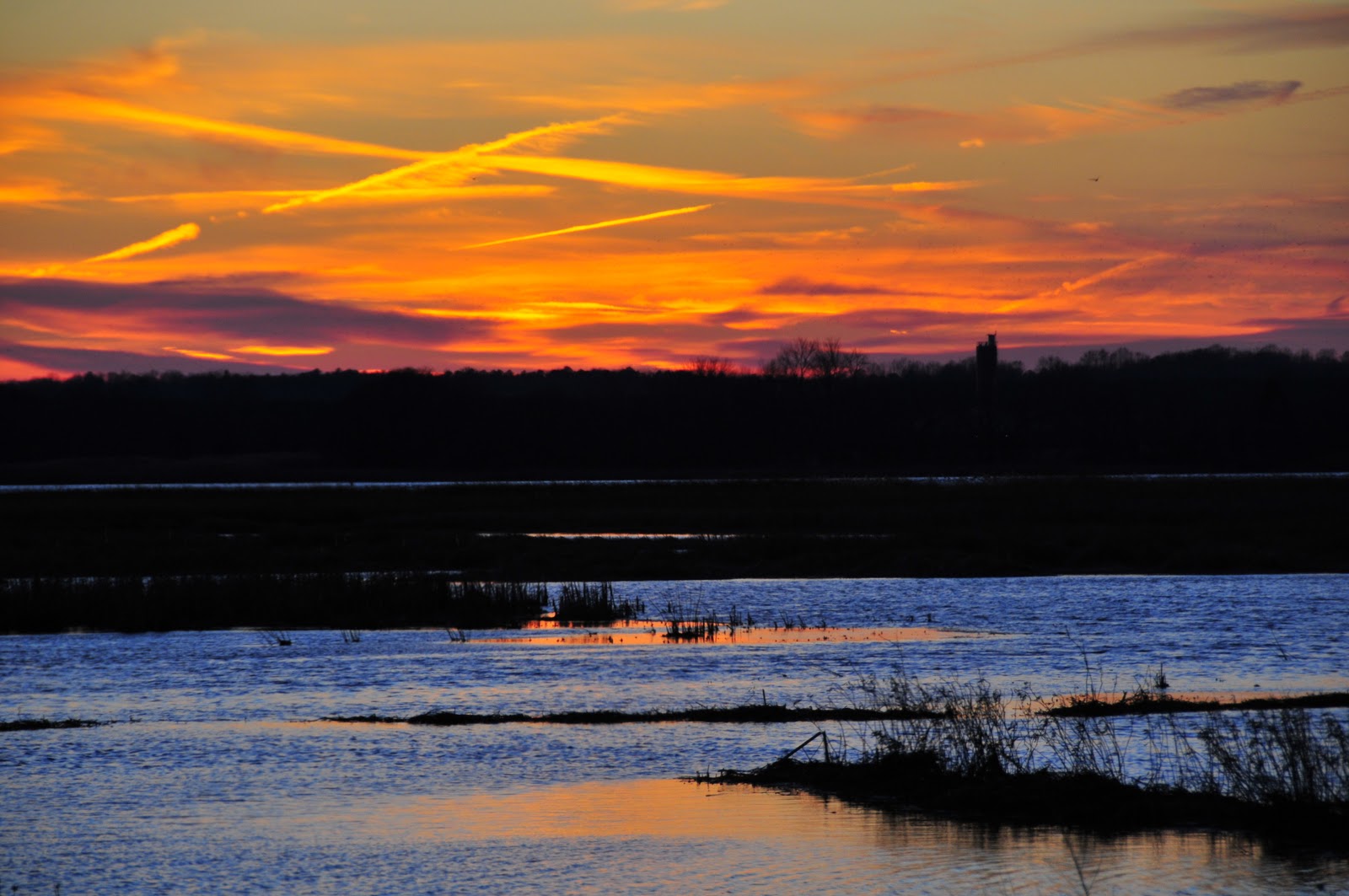
The day was coming to a close but we absolutely could not pass up Williamsburg without at least driving to see the main block of historic Williamsburg.  As quaint as the town was, it was the trip in and out of Williamsburg that held A. Paul's and my attention.  The changing reflection of the sky on water was too alluring to not stop and photograph and once we began we simply could not stop capturing the changing environment as we passed from sea level  at Williamsburg to below sea level under the Chesapeake Bay while on the Hampton Bridge to Norfolk.  We leave you with these images to end your day.  Tomorrow we take in the Chrysler Museum then off to scout out Beaufort, Morehead, and Wilmington NC.
 
 
Trees outside Williamsburg

Entering the tunnel under Chesapeake Bay


Norfolk


Monday, January 24, 2011

Smithsonian & National Gallery of Art

SMITHSONIAN

Smithsonian Institute Building
 It was a chilly day but the sun was in full force in D.C.  Today, A. Paul & I dedicated the full day to exploring the galleries along the Mall.  If you have never been in Washington, D.C.,  the Mall is not a shopping mall.  It is the major open park region sandwiched between Constitution and Independence Avenues, stretching between the Lincoln Memorial to the Capitol Building.  Pennsylvania Avenue lies on the hypotenuse connecting the Captiol Building in a straight line to the White House.  Along the sides of the Mall  and surrounding areas are where most major galleries and government buildings are located.   The natural starting spot for us along the Mall was the Smithsonian Institute, the world's largest research complex with mutilple galleries, national zoo, and research facilities, established in the late 1800s by the bequest of James Smithson, an English Chemist and mineralogist.  http://www.si.edu/   The Smithsonian serves as the central information center to its surrounding galleries.


 " The Balcony"  J. Whistler
Once we were acclimated to the lay of the galleries, we ventured off to the Freer and Sackler Galleries adjacent to the Smithsonian. Our main focus was to study the collection of the American painter James McNeill Whistler and collection of Asian Arts, which greatly influenced Whistler's work.  One of the highlights in the Whistler exhibit was the Peacock Room, a complete dining room designed by Thomas Jekyll for a London shipbuilder, Frederick Leland, one of Whistler's major patrons. The room was created to house Leland's major collection of blue & white asian 
The Peacock Room
porcelain. During the process of building the room,  the architect died unexpectedly and Whistler took over the project.  Towards the completion of the room, a rift developed  between Leland and Whistler resulting in Whistler's painting of the two fighting peacocks on the back wall.  To read more about Whistler's work and the Peacock Room, visit the Freer Sackler site http://www.asia.si.edu/ .


Exterior of Hirschhorn Gallery

 Next we changed up our viewing pace with contemporary arts at the Hirshhorn Gallery.  The building itself  is a marvel in contemporary architecture, befitting for the collection held within.

escalator into Hirschhorn

Franz Kline

The collection was rich with Koonigs, Calders, Dubuffets, Brancusis, Moores, and we were fortunate to even take in another Franz Kline.

Following our visit to Hirshhorn we wandered across the Mall, attempting to avoid the gathering rally ascending on the Capitol.  Nothing like being a part of the news in the making!

Pro Life Rally on DC
anniversary of Roe v Wade
We fled across the Mall to the National Gallery of Art where the rest of the day was to be consumed.  The NGA is extraordinary and monumental in all aspects, architecturally and breadth of collection.  We attempted to utilize the free self guided tour gadgets but found them inefficient as you had to hold it like a phone receiver and was limited in offering information on the pieces within any one salon of work. However, the collection itself more than made up for the loss of the guide.

Thomas Eakins "Study of Banjo Player"
The gallery collections ranged from early 13th to 16th century artists, Italian, Spanish, Netherlandish, German, Dutch and Flemish, to 18th - 19th century British, American, and French artists in the West Building.   After a quick bite in the gallery cafe and glance through the gallery bookstore, we were off to the East Building of Contemporary Arts to take in Warhol, Miro, O'Keefe, Giacometti, Hofmann and others.  After numerous hours of viewing art, A. Paul  I were gleefully on overload.  The rally outside was just winding down in time for us to take a brisk stroll back to the hotel several blocks away, ruminating on our visual indulgences.
"Repose" Sargent
Tomorrow we take in the Phillips Collection, a must see before we leave.  To do so means we must shift our driving schedule to accommodate our morning viewing.  We will be on the road to Richmond, Virginia and possibly land in Norfolk, Virginia by nightfall.  I will try to post the next blog tomorrow evening, if possible, but if not, certainly by the next day to discuss the Phillips Collection and other adventures along the way to Virginia's eastern coastline.

Last closing remarks, thank you Cliff from Principle Gallery in Alexandria for the name correction.  We are glad you found the blog successfully.


A. Paul among Matisse Cut Outs


Sunday, January 23, 2011

Day in Alexandria, VA & Washington DC Images


Torpedo Factory  Alexandria, VA
A. Paul with Sheep Jones
It was a very chilly day here in the DC area.  Given this, A. Paul and I decided to use the car for shelter and visit the Torpedo Factory, a WWII torpedo factory converted into an Arts Center, across the Potomac River.  The Arts Center sits along the riverfront in historic Alexandria, Virginia, and houses 6 galleries and 82 working studios occupied by 165 artists.  Artists' works range from ceramic, fiberwork, metalwork, paintings, jewelry, and prints.  Each artist at the Torpedo Factory is selected through a juried process in order to gain space in a studio. The studios that were open, we found the artists to be informative, welcoming and open to sharing insights into their techniques. 

Our first encounter was with Sheep Jones of Studio 7,  who introduced A. Paul to her use of cold wax medium in her paintings, providing a hands on demonstration of its properties in oil painting. Sheep's works, whether small or large, are rich with intense color and layers.  You can check out her work at http://www.sheepjones.com/ or at http://www.factorystudio7.com/.


A. Paul with printmaker Phyllis Cohen

Cecelia Burnett
 In the next two studios, we met up with Cecelia Burnett, who works in acrylic washes that have a fine silkscreen appearance on canvas, and with Phyllis Cohen, a printmaker who has been with the Printmakers Inc at Torpedo Factory since its inception 35 years ago. Phyllis was very familiar with our small town as she has a personal collection of whiteline wood block prints from Provincetown, though she herself pratices the Japanese woodblock printing technique in her work.  To see these two artirsts' works, visit ceceliaburnettpaintings.com/  and the printmakers site http://www.tfpi.org/

As of last year, the Torpedo Factory began offering summer artist in residence programs, which was very successful and will be implemented again this summer.  You can read more about the studios, galleries, art school, and visiting artists programs on the Torpedo Factory site  http://torpedofactory.org/ .

torpedo on display inside the art center

Clint & Kerry Filiberto at Principle Gallery
A short walk down King Street , one of the major mainfares in Alexandria, was the Principle Gallery.  We made a quick jog into the gallery and spoke with Clint, who gave us a more personal introduction to main artists of the gallery.  You can check out the gallery site principlegallery.com/  .

Also helpful was Zoe Atarodian, Assistant Gallery Director at PC Art, next door to Principle Gallery, who provided us information on a new artists complex in Lorton, VA, called the Workhouse Arts Center.  We are not sure that we will be able to put it on our schedule due to the facility being closed until Wednesday,  which is a great loss for this trip given the size of the complex.  The Workhouse Arts Center has been open only since 2008 and is a converted correctional facility over 200,000 square feet that now houses working artist studios, galleries, and workshops.  Artists, whether interested in teaching a workshop or taking one, can check out their website at workhousearts.org  .

Washington, D.C.

Ascending the metro to Dupont Circle

Washington Monument
 A quick jog back across the Potomac and a quick metro trip to Dupont Circle, A. Paul and I scouted out galleries along R Street, Q Street, and 14th Street.  A quick bite at a local eatery and we were off on a cab ride to Georgetown to see what was happening along M Street.  Though the weather was brutally frigid, shoppers still found enough energy to dart in and out of the shops along the way.  A. Paul and I decided that we had enough of the cold and are savoring tomorrow's visit to the Smithsonian and other galleries along the Mall.  We leave you with a small taste of the structural beauty of Washington DC and look forward to sharing our finds at the museums tomorrow.  Tuesday we await our visit to the Phillips Collection.

View down Pennsylvania Avenue


Saturday, January 22, 2011

Easton MD to Washington DC

EASTON, MARYLAND

www.tidewaterinn.com/
 
John General  owner Tanuki's
After a meal & gratis nightcap at General Tanuki's restaurant and a very comfortable stay at the historic Tidewater Inn, dating back to 1712, A. Paul and I were ready to explore the arts in Easton,

First on the list was the Academy of Art located just down the street from the center of town.  The Academy was founded in 1958 with a mission to rotate exhibits of national interest as well as offer workshops , lectures, and classes in the arts.  There was a significant emphasis on photography both in the current exhibit and in the course being conducted on the upstairs level of the academy.
Alex Maclean's "B-52 Bone Yard" aerial photo
The current exhibit " Constructed Spaces: Contemporary Color Photography", though small, was thought provoking in content.  The works intent was to capture the world around us as it really is, whether it be abandoned fields of airplanes, deserted houses and cars, or eerie woods of winter cloaked sculptures; one could not walk away from the exhibit without feeling intropective about the work. 


academyartmuseum.org/ 
In another salon of the academy there was a fabulous collection of wood engravings by Fritz Eichenberg depicting highly detailed imagery of the Old Testament of the Bible.
Fritz Eichenberg etching
On the second level of the center, one could find an exquisite collection of 20 oyster plates on loan from a private collection of more than 350 pieces. 

After visiting the academy, A. Paul and I ventured around Easton's two main streets, Washington and Harrison, where several galleries dotted the sides of the road.  We made a short stop in the Market Center where every Saturday farmers, including a group of Amish farmers, bring their bounty of earthly goods.  Today, given the frigid weather, the market was limited but the interior market stalls were open.  It is here I stumbled across some of the best, homesmoked salmon with scrumptious glazing that I have ever tasted.  This small company does not yet ship their salmon but are in the process of setting up the ability to do so by next year.  Tomorrow, I promise to pass on the website as you just might want to keep it on hand, it is that good. 
Tilghman Island

After visiting the art scene in Easton, A. Paul and I headed out to Washington DC, stopping in St. Michaels, Tilghman Island and Annapolis for photo shoots along the way. 

Bridge into Annapolis
Annapolis, home of the US Naval Academy, is a charming seaport city which lies just outside Washington D.C.  A stop for a quick bite to eat and walk along the harbor was not enough to take in everything this city has to offer. It definitely will make my list to come back to one day and spend more time exploring.

After a small break in Annapolis, we reached D.C. just in time to catch the day's end light setting behind the White House, which literally is around the corner from the hotel.  We will spend the next few days in DC visiting the Smithsonian, Phillips Collection, and other art venues throughout the city.  We hope that everyone is staying warm and safe during this cold spell. 


White House


Friday, January 21, 2011

Settled in Easton Maryland--alas

Philadelphia to Easton

Easton, Maryland
What an incredible day today has been on so many levels.  We left Philly with snowcapped high rises
and landed in Easton, MD  with a glorious sunset, welcoming our arrival on the shores of Maryland. 

The inbetween of the day was marked by brisk walks and visits with a handful of artists in Millville, NJ,  viewing Victorian rowhouses along the beaches of Cape May, and taking a rock n' roll ferry trip  (and I don't mean the musical type)  across the Delaware Bay.
 Millville is about an hours drive south of Philly and is historically known for its glassworks, with a coveted paperweight as its namesake, the Melville Rose.   Due to its abundance of natural resources needed for making glass, Southern New Jersey became the center of the American glass industry with its ealiest successful glass factory founded in 1789 by Caspar Wistar.  Along side the efforts of early pioneers, such as Wistar and Dr. Wheaton,  a pharmaticist who had his pharmaceutical bottles made by a Millville glass company, it was Wheaton's grandson who cemented Millvilles ability to continue its deep association of glass today through Wheaton Arts Center, a working glass studio and museum of american glass art.  The Wheatons first collection was held in their residence on High Street in Millville, which today is embracing the arts as means to revitalize High Street into an arts district, which was later moved into the Wheaton Arts Center.

During this leg of our journery,  A. Paul and I had the opportunity to walk High Street and visit the few open businesses/galleries along the road followed by a  drive to nearby Wheaton Arts Center. Both visits were informative and inspiring.

At Wheaton Arts Center, we resourcefully poked around until we caught the attention of someone in one of the main studios.  As it happened, it was the glass studio within the center.  The center closes at the start of January but the main entrance to the quasi-Victorian village  is still open for museum viewing during Jan - March, when the season begins again for the Arts Center, thus why we were able to poke around.

Kerry Filiberto and Andrew Newbold
Inside the glass studio, we hooked up with three sociable and likable artists, Don Friel, one of three artists who continue to make the Mellville Rose paperweight, Andrew Newbold, who works in various mediums, and Max Lefko, a Northamption artist now living in Millville.

The large space surrounding the major central kiln can seat  50+ people and in season the studio is most commonly used as a working demonstration center where apprentice and laymen learn the secrets of glassmaking, though one is hands on and the other through viewing.  Though none of the artists we spoke to actually have their own website, you can read about the history of the Wheaton Center and Don Friel is a featured artist on the site  http://www.wheatonarts.org/

A. Paul with Don Friel, left

Our jaunt down the main street of Millville, called the Glassart District, was closed to through traffic due to the total collapse of its 1905 theater, A. Paul and I were able to walk the streets and visit one ceramic works studio run as an extension to Cumberland County College called Clay College.

The 150 feet long studio with 15 pottery wheels and four kilns is a fully functional studio with gallery exhibit space at the front.  According to the Clay College director, Jacqueline Sandro, the school participates in the Third Friday openings alongside other businesses and galleries on the street where she exhibits the works of its students. 

Clay College Ceramic Studio  Sharon (r) and Jean (l)
When we visited the site, there were two wonderful, non traditional students, Sharon Vitale and Jean Helmer, who were working on their ceramics. Both were kind enough to continuing working while A. Paul photographed them. 


Sharon Vitale
The other major center on High Street is the Renaissance Center, which was unfortunately closed.  The town of Millville definitely demonstrates a commitment to advancing the arts and should be on anyone's list to visit but I would suggest in season to experience it fully.

Cape May
Cape May

White beaches, victorian style houses, and fun. Though the town itself was in hibernation, it is easy to see that Cape May is a quaint, fun loving beach town.   Long stretches of white sand balance the colorful rows of new and revived victorian homes that dot the main beach road.  About two blocks into town is a walking-only shopping district.


After a short frolic on the beach, we headed to N. Cape May to catch our hour twenty minute ferry ride across the Delaware Bay.  The ride was a bit cool and bumpy but we simply bundled up in the car and headed out with the sun on our faces.

Once on the other side, Delaware and Maryland's wide open fields were drenched in soft hues of colors, with an enchanting, dream-like sunset greeting us. 

Tomorrow we explore Easton's Academy of the Arts and make our way to Washington, DC.


Entering Easton